12th FIELD ARTILLERY BATTALION
Battery C
Note: the 12th Field Artillery Battalion was in general support of the entire 2nd Infantry Division as a whole, providing reinforcing fire. This battalion was armed with 155 mm howitzers. Therefore, it was not paired with an Infantry Regiment.
- + 12th Field Artillery Battalion
- Battalion Headquarters (Hq)
- Battery Headquarters (Hq)
- Battery A: 4 x 155mm Howitzers.
- Battery B: 4 x 155mm Howitzers.
- Battery C: 4 x 155mm Howitzers.
- Service Battery: The "muscle" and logistics. They ran the M5 Tractors and brought the 95lb shells forward to the guns.
- Medical Detachment: The battalion's own doctor and medics
- Battalion Headquarters (Hq)
Shell Weight: Each high-explosive shell weighed about 43 kg (95 lbs which is 6.8 Stone ! ).
Range: It could hit targets over 14 kilometres (approx. 9 miles) away.
Transport: These guns were too heavy to be pulled by horses or light trucks; they were towed by massive M5 or M4 high-speed tractors (often called "Prime Movers").
DEPARTURE FROM GOSFORD CASTLE IRELAND
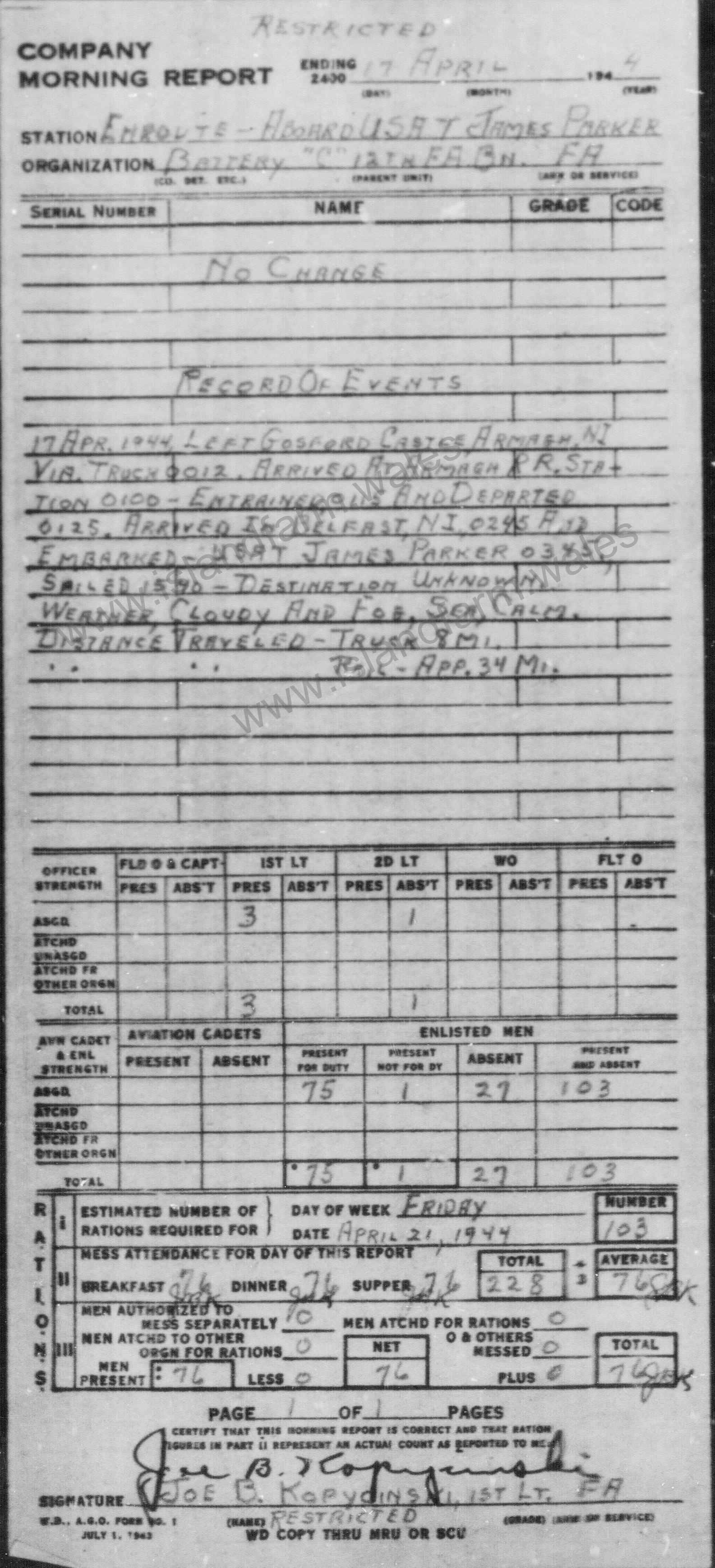
17 April 1944 - Battery "C", 12th FA Bn
Personnel Changes
No Change
Record of Events
- 0012: Left Gosford Castle, Armagh, NI via truck.
- 0100: Arrived at Armagh RR Station.
- 0115: Entrained.
- 0125: Departed.
- 0245: Arrived in Belfast, NI.
- 0345: Embarked USAT James Parker.
- 1540: Sailed Destination Unknown.
Conditions: Weather cloudy and fog, sea calm.
Distance: Travelled 8 miles by truck and approximately 34 miles by rail.
Personnel Strength
- Officers: 4 Assigned (3 1st Lts, 1 2nd Lt).
- Enlisted Men: 103 Total (75 Present for duty, 1 Present not for duty, 27 Absent).
Authentication Signature: Joe B. Kopycinski, 1st Lt, FA
Explanation of Shortened Text
- NI: Northern Ireland.
- RR Station: Railroad Station.
- Entrained: Boarded a train.
- USAT: United States Army Transport.
- FA: Field Artillery.
Summary
The morning report for Battery C, 12th Field Artillery Battalion, dated 17 April 1944, documents a day of intensive movement. Shortly after midnight, the unit departed Gosford Castle and travelled by truck and rail to reach Belfast. By early morning, the men had embarked upon the USAT James Parker and sailed at 1540 for an unknown destination. Despite the cloudy and foggy weather, the sea remained calm as the battery began its journey away from the Irish harbour. At the time of departure, the unit consisted of 4 officers and 103 enlisted men under the command of 1st Lieutenant Joe B. Kopycinski.

USAT James Parker (United States Army Transport)

18 April 1944 - Battery "C", 12th FA Bn
Personnel Changes
No Change
Record of Events
- Location: Aboard USAT James Parker
- Arrival: Arrived and docked in Newport Harbour, England (Correction Wales) at 1605
- Weather: Fog, cloudy to clear
- Sea Conditions: Calm
- Morale: Very Good
Personnel Strength
- Officers: 4 Assigned (3 1st Lts, 1 2nd Lt)
- Enlisted Men: 103 Total (75 Present for duty, 1 Present not for duty, 27 Absent)
Authentication Signature: Joe B. Kopycinski, 1st Lt, FA
Explanation of Shortened Text
- USAT: United States Army Transport (a type of military troopship).
- Btry "C": Battery C.
- 12th FA Bn: 12th Field Artillery Battalion.
- FA: Field Artillery.
- Eng.: England.
- 1605: 4:05 PM.
Summary
The morning report for Battery C, 12th Field Artillery Battalion, dated 18 April 1944, records the unit's arrival in the United Kingdom. While aboard the USAT James Parker, the battery reached and docked in the harbour at Newport, England, at 1605. The day's weather transitioned from fog and clouds to clear skies, with the sea remaining calm. Despite the long journey travelled from Northern Ireland, 1st Lieutenant Joe B. Kopycinski reported that morale remained "Very Good" among the 4 officers and 103 enlisted men.
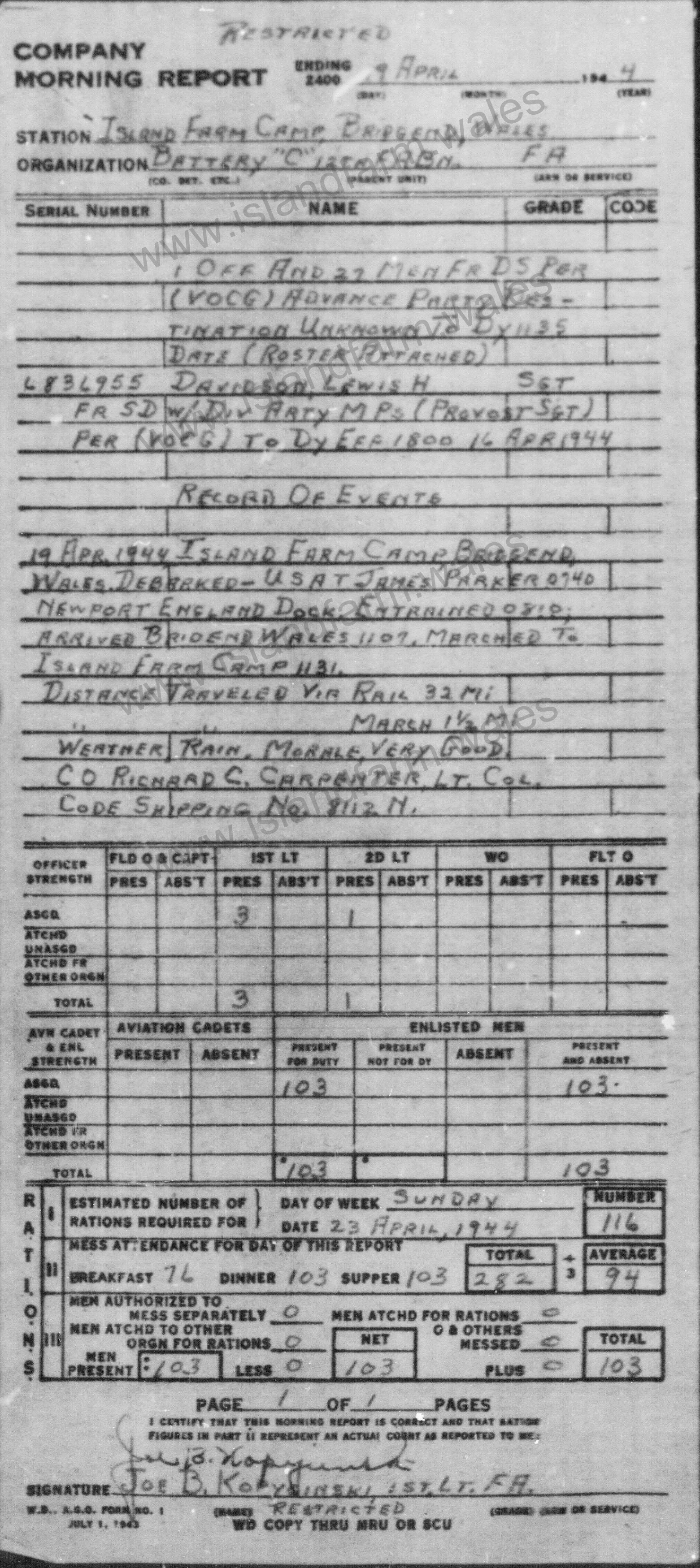
19 April 1944 - Battery "C", 12th FA Bn
Personnel Changes
- Advance Party (1 Officer and 27 Men): Changed from DS (Detached Service) destination unknown to duty at 1135 (per VOCG) (Roster Attached).
- Davidson, Lewis H (6836955) Sgt: Changed from SD (Special Duty) with Div Arty MPs (Provost Sgt) (per VOCG) to duty effective 1800 16 April 1944.
Record of Events
- 0740: Debarked USAT James Parker at Newport England Dock.
- 0810: Entrained.
- 1107: Arrived Bridgend, Wales.
- 1131: Marched to Island Farm Camp.
- Distance Travelled: Via Rail 32 Mi; March 1.5 Miles.
- Conditions: Weather Rain,
- Morale: Very Good.
- Command: CO Richard C. Carpenter, Lt. Col.
- Shipping Info: Code Shipping No. 8112 N.
Personnel Strength
- Officers: 3 Assigned (3 1st Lts).
- Enlisted Men: 103 Total (103 Present for duty).
Authentication Signature: Joe B. Kopycinski, 1st Lt, FA
Explanation of Shortened Text
- DS: Detached Service (temporary assignment away from the home unit).
- VOCG: Verbal Order of Commanding General.
- SD: Special Duty.
- Div Arty MPs: Division Artillery Military Police.
- Provost Sgt: A sergeant in charge of police-related duties within a military unit.
- Debarked: Disembarked or got off the ship.
- Entrained: Boarded a train.
Summary
The morning report for Battery C, 12th Field Artillery Battalion, dated 19 April 1944, chronicles the unit's final arrival at Island Farm Camp in Bridgend. After arriving at the harbour in Newport, the men debarked the USAT James Parker at 0740 and travelled 32 miles via rail to Bridgend. Upon arrival, they completed a 1.5 mile march to their new camp under rainy conditions, yet 1st Lieutenant Joe B. Kopycinski reported morale as "Very Good". The day also saw the return of an advance party consisting of one officer and 27 men from detached service, as well as Sergeant Lewis H. Davidson's return to regular duty from his post as a Provost Sergeant with the Division Artillery MPs.
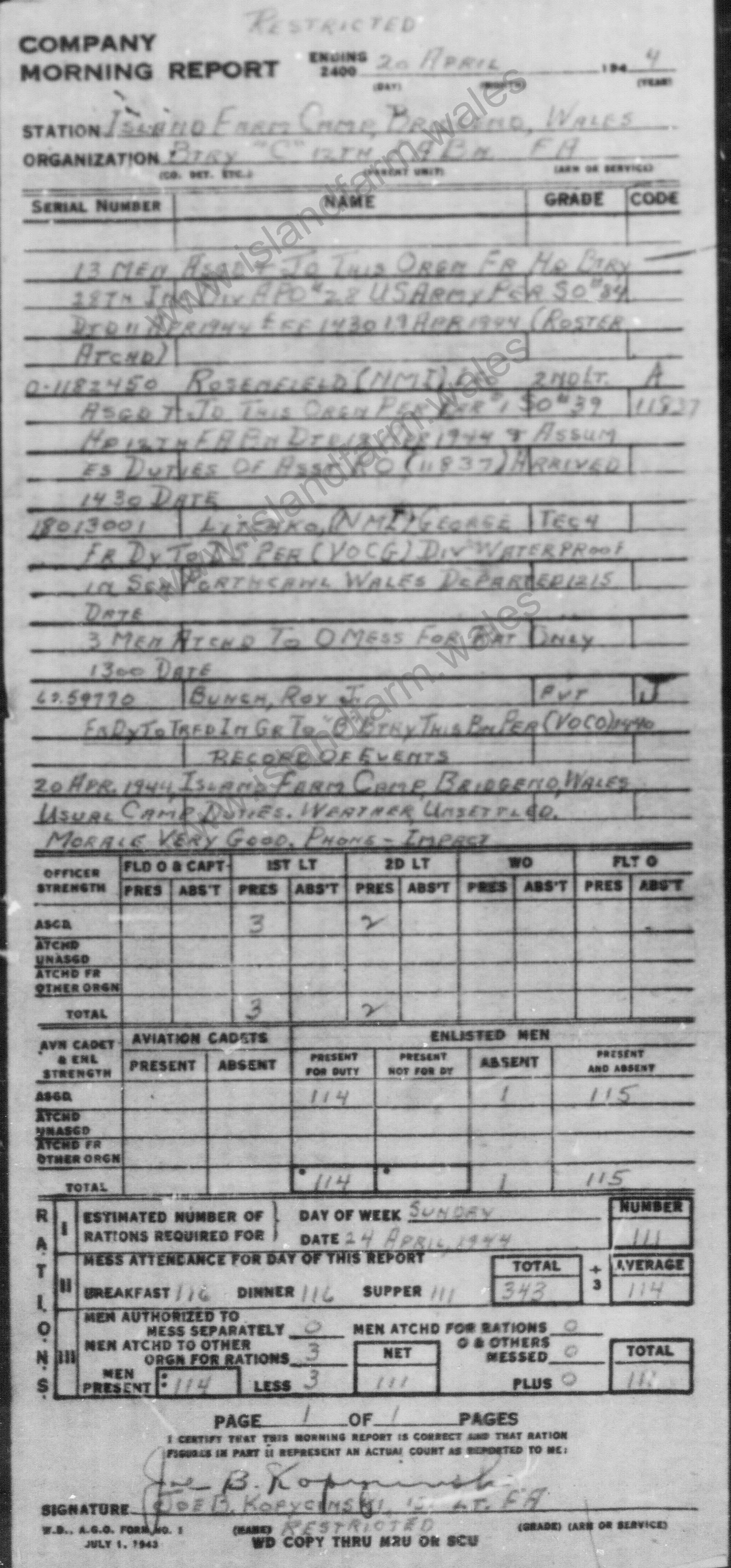
20 April 1944 - Battery "C", 12th FA Bn
Personnel Changes
- 13 Men: Asgd & jd (Assigned and joined) this orgn fr Hq Btry 108th Inf Div APO #28 US Army per SO #84 dtd 11 Apr 1944 eff 1430 19 Apr 1944 (Roster Attached).
- Rosenfield, Leo (O-1182450) 2nd Lt: Asgd & jd (Assigned and joined) per Par 1 SO #39 Hq 12th FA Bn dtd 19 Apr 1944; assumed duties of Asst RO (Assistant Reconnaissance Officer); arrived 1430.
- Litchko, George (18013001) Tec 4: Fr Dy to DS per (VOCG) Div Waterproofing Sch Porthcawl Wales; departed 1215.
- 3 Men: Atchd to mess for rat only (Attached to mess for rations only) 1300.
- Bunch, Roy J. (6259770) Pvt: Fr Dy to trfd in gr to "B" Btry this Bn per (VOCO) 1440.
Record of Events
- Location: Island Farm Camp, Bridgend, Wales.
- Activity: Usual camp duties.
- Weather: Unsettled. Morale: Very Good.
- Note: Phone Impact.
Personnel Strength
- Officers: 5 Assigned (3 1st Lts, 2 2nd Lts).
- Enlisted Men: 115 Total (114 Present for duty, 1 Absent).
Authentication Signature: Joe B. Kopycinski, 1st Lt, FA
Explanation of Shortened Text
- Asgd & jd: Assigned and joined (the soldier is officially on the roster and present).
- SO / Par: Special Order / Paragraph.
- Asst RO: Assistant Reconnaissance Officer.
- DS: Detached Service (temporary assignment away from the battery).
- VOCG / VOCO: Verbal Order of Commanding General / Verbal Order of Commanding Officer.
- Trfd in gr: Transferred in grade (transferred while keeping the same rank).
- Atchd to mess for rat only: Attached for meal purposes only, likely from another unit.
Summary
The morning report for Battery C, 12th Field Artillery Battalion, dated 20 April 1944, marks a day of reorganization at Island Farm Camp. The battery grew with the arrival of 13 men from the 108th Infantry Division and the assignment of 2nd Lieutenant Leo Rosenfield as Assistant Reconnaissance Officer. Notably, Private Roy J. Bunch was transferred out of Battery C to Battery B at 1440 hours. While Technician 4th Grade George Litchko travelled to the waterproofing school in the harbour town of Porthcawl, the remaining men performed usual camp duties under unsettled weather with "Very Good" morale.

23 April 1944 - Battery "C", 12th FA Bn
Personnel Changes
- Litchko, George (18013001) Tec 4: Fr dy to DS per (VOCG) Div Waterproofing Schl Porthcawl Wales Departed 1215 Date.
- Correction: Above remark M/R dtd 20 April 1944 corrected as follows: Fr dy to SD per (VOCG) Div Waterproofing Schl Porthcawl Wales Departed 1215 Date.
- Cameron, Walter W (11007086) Pvt: Asgd & jd this orgn fr Hq FERD #1 APO #872 per par #13 SO #81 2d Inf Div dtd 19 April 1944 Arrived 2100 date. (Note: Race code G appears next to name).
Record of Events
- Location: Island Farm Camp, Bridgend, Wales.
- Activity: Usual Camp Duties.
- Weather: Cloudy.
- Morale: Very Good.
Personnel Strength
- Officers: 5 Assigned (2 1st Lts Pres, 1 1st Lt Abs't, 2 2nd Lts).
- Enlisted Men: 116 Total (113 Present for duty, 2 Present not for duty, 1 Absent).
Authentication Signature: Joe B. Kopycinski, 1st Lt, FA
Explanation of Shortened Text
- DS: Detached Service (temporary assignment to a different location).
- SD: Special Duty (performing a specific task while remaining with the unit; this corrected the previous entry for Litchko).
- VOCG: Verbal Order of Commanding General.
- Schl: School.
- M/R dtd: Morning Report dated.
- Asgd & jd: Assigned and joined.
- Hq FERD: Headquarters, Field Exercise and Replacement Depot.
- SO: Special Order.
Summary
The morning report for Battery C, 12th Field Artillery Battalion, dated 23 April 1944, notes the continued operations at Island Farm Camp in Bridgend. The document includes a formal correction to the status of Technician 4th Grade George Litchko, clarifying that his assignment to the waterproofing school in the harbour town of Porthcawl was Special Duty (SD) rather than Detached Service (DS). Additionally, the battery welcomed a new member, Private Walter W. Cameron, who travelled from the Field Exercise and Replacement Depot to join the unit at 2100 hours. Despite cloudy weather, morale remained "Very Good" as the men carried out their usual camp duties.

29 April 1944 - Battery "C", 12th FA Bn
Personnel Changes
No Change
Record of Events
- Location: Island Farm Camp, Bridgend, Wales
- Activity: Usual camp duties
- Weather: Clear
- Morale: Very good
- Status Update: ALERTED FOR DEPARTURE
Personnel Strength
- Officers: 6 Total (3 1st Lts, 2 2nd Lts present; 1 2nd Lt absent)
- Enlisted Men: 116 Total (108 Present for duty, 8 Present not for duty)
Authentication Signature: Joe B. Kopycinski, 1st Lt. FA
Explanation of Shortened Text
- Btry. "C": Battery C
- 12th FA Bn.: 12th Field Artillery Battalion
- FA: Field Artillery
- 1st Lt. / 2nd Lt.: First Lieutenant / Second Lieutenant
Summary
The morning report for Battery C, 12th Field Artillery Battalion, dated 29 April 1944, indicates that the unit reached full operational readiness at Island Farm Camp. Under clear skies, the men performed their usual camp duties with morale described as "very good". Most significantly, the report concludes with the entry ALERTED FOR DEPARTURE, matching the status of Battery B from earlier that week. This signals the end of their brief stay in the Bridgend area following their arrival from the Newport harbour. At this time, the battery strength consisted of 6 officers and 116 enlisted men under the command of 1st Lieutenant Joe B. Kopycinski.

30 April 1944 - Battery "C", 12th FA Bn
Personnel Changes
- McConnell, Johnny C. (6958328) S/Sgt
- Schroeder, Johnnie T (38421221) Tec 5
- Hanlon, Harold E. (31200759) Tec 5
- Bumguardner, Homer L (18011176) Tec 5
- Smith, James D. (6950244) Tec 5
- Wyatt, George L. (18043352) Pvt.
- Rosenfield, Leo (O-1182450) 2d Lt
- Remark: Above 1 Off and 6 men fr SD Depot G-25 to Dy Arr 2330 date.
- Currier, Paul M. (18012804) Tec 5
- Renken, Perry (18012925) Sgt
- Remark: Above 2 men fr Dy to sd (VOCG) Waterproofing Sch Porthcawl Wales Departed 0900 date.
Record of Events
- Location: Island Farm Camp, Bridgend, Wales
- Activity: Paragraph 1a and 1b of letter Hq V Corp, subject: "Desertion" dated 21 April 1944 (cont'd on page 2).
Personnel Strength
- Officers: 5 Assigned (3 1st Lts, 2 2nd Lts).
- Enlisted Men: 116 Total (112 Present for duty, 4 Present not for duty).
Authentication Signature: Joe B. Kopycinski, 1st Lt. FA
Explanation of Shortened Text
- fr SD Depot G-25 to Dy: From Special Duty at Depot G-25 to regular duty.
- Arr 2330 date: Arrived at 11:30 PM on this date.
- fr Dy to sd: From regular duty to Special Duty.
- VOCG: Verbal Order of Commanding General.
- Hq V Corp: Headquarters, V Corps.
Summary
The morning report for Battery C, 12th Field Artillery Battalion, dated 30 April 1944, records significant personnel activity as the unit prepares for deployment from Island Farm Camp. Seven members, including 2nd Lieutenant Leo Rosenfield and Staff Sergeant Johnny C. McConnell, returned to regular duty late in the evening after completing Special Duty at Depot G-25. Meanwhile, Sergeant Perry Renken and Technician 5th Grade Paul M. Currier travelled to the nearby harbour town of Porthcawl to attend the Waterproofing School. Similar to Battery B earlier in the week, the day also included a formal reading of military orders regarding "Desertion" from V Corps Headquarters.
Interesting observations
The morning reports for the 12th FA Battalion reveal slight discrepancies in the timing and atmospheric conditions of their departure.
While the batteries moved in a staggered sequence from Gosford Castle between 00:05 and 00:15, their observations of the weather varied significantly.
Batteries A and B recorded the conditions as fair, yet Battery C noted a transition to a cloudy and foggy afternoon as they waited in the Belfast harbour.
Furthermore, while most recorded the USAT James Parker setting sail at 16:00, Battery C noted the departure twenty minutes earlier, at 15:40.