No. 53
 |
|
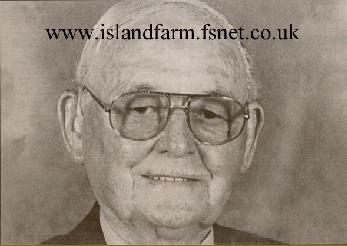
Gwilym Elwyn Lloyd
1912 - 2001 |
During WWII an overspill country branch of the Woolwich Arsenal was built at Waterton on the outskirts of Bridgend. The Royal Ordnance Factory, No 53 - known as "The Arsenal & The Admiralty" to locals, was opened in 1938 a year before the outbreak of WWII. It was constructed in two distinct sections, one for storing ammunition (The Arsenal) and the other as a shell-filling factory for the Navy (The Admiralty).
Gwilym Elwyn Lloyd, aged 89 and buried 13th October 2001 is best remembered for his part in the construction and development of the Royal Ordnance Factory (ROF) at Bridgend, Glamorgan.
He was awarded the British Empire Medal in 1972 for his dedication to British industry after he painstakingly mapped the site following the Second World War.
His son Graham, from Brackla (Near Bridgend), said:
"My father started off as a miner in Pentrebach, near Methyr Tydfil, when he was 14. He quickly realised that wasn't for him so he moved to London, trained as a carpenter and started work for the original HMV record company making vaneer units. He moved to Bridgend in 1936 and began work on the Arsenal. It had 1,000 buildings and my father knew them all intimately. After the war the Arsenal was demolished and turned into an industrial estate, but because all the top secret documents detailing the land were destroyed, my father was asked to help catalogue where the pipes and foundation lay"
In the 1970s Mr Lloyd, a keen inventor and entrepreneur, developed the Bridgend / Brackla ROF factory site where he patented and developed a set of bellows for inflatable boats. He also became an associate member of the Bath Institute of Medical Engineering after a respirator he had invented saved a young girl's life.
This part of the factory, south of Bridgend town centre, made such a vast quatity of shell casings for the Navy that the site had the nickname of the Admiralty. The completed shells were then transferred to the second part of the site known as The Arsenal" in Brackla (via rail) for filling and storage. During its peak production 40,000 people worked in the two factories making it the largest employee factory that has ever been in Britain! Most of the men in Great Britain would have been in the forces (Army, Navy, RAF), so consequently the vast quantity of this work force would have been women,

Recruitment AdvertClick image to enlarge
|

This photo profile is left of right photo heading in the direction of Coity and The
ArsenalClick image to enlarge
|

Photo profile is looking from end of Cowbridge Road towards CoychurchClick image to enlarge
|

Factory Warning SignClick image to enlarge
|

Workers arriving at Tremains Holt Railway platform just
outside Bridgend Main Railway Station.
Click image to enlarge
|

Workers arriving at Tremains Holt Railway platform just
outside Bridgend Main Railway Station
Click image to enlarge
|
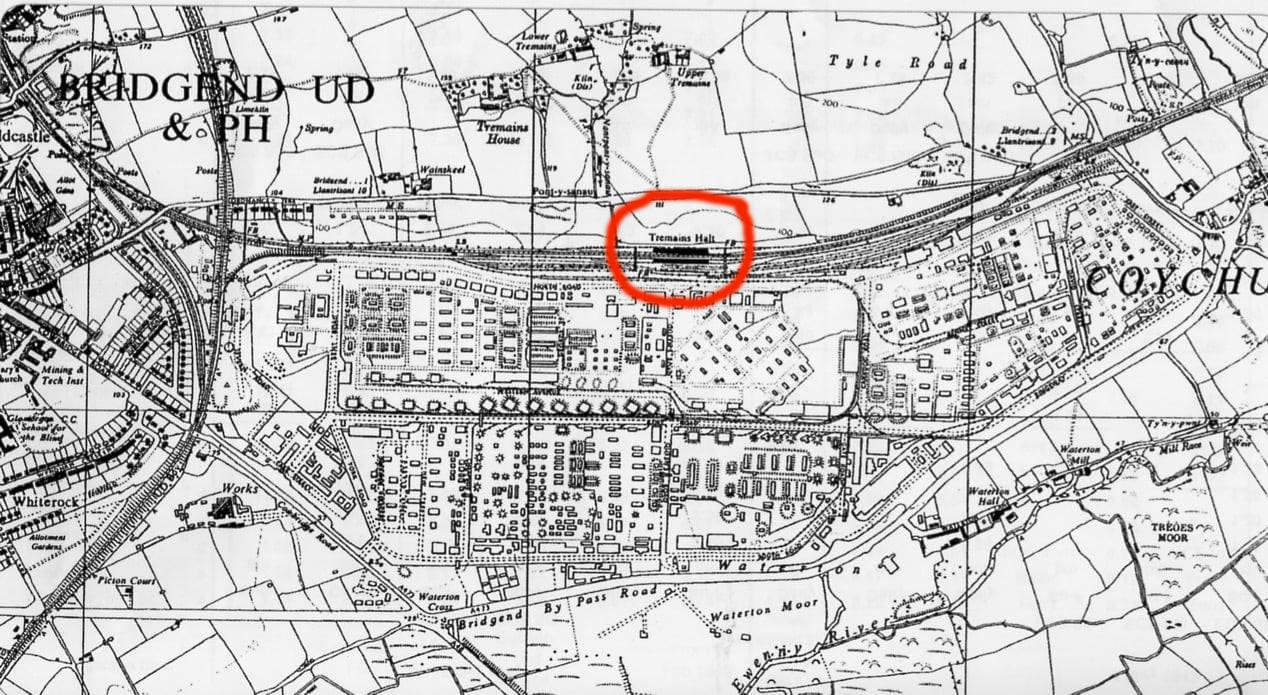
Plan of the Admiralty with Tremains Holt highlightedClick image to enlarge
|

Workers arriving for work This is today the main entrance to the South Wales Police Head Quarters (Cowbridge Road) Click image to enlarge |

Buses waiting to transport workers.
Spot the chimney in the top right hand corner ? This can be seen in the Waterton Aerial photo taken by the RAF (See next page) Click image to enlarge |

Workers leave for their homes in Abergwynfi & Ferndale
Click image to enlarge
|

The main entrance to the ROF Factory 53 known as the
"Admiralty".
Today, this is site of South Wales Police Headquarters. This photo was taken 10th April 2015, prior to massive redevelopment in which an additional floor was added. Click image to enlarge |

Royal Ordnance Factory Uniform Badge
Click image to enlarge
|

1940 Ratner Safe
which is still in the admin block today! Click image to enlarge |

Inside door of the safe the salaries are written!
Click image to enlarge
|

7th September 1943
Salaries ! Click image to enlarge |

Note the high earth walls. These were intended to prevent
a "domino effect"
should there be an explosion in one of the buildings.
Click image to enlarge
|

Making small shell rounds
Click image to enlarge
|
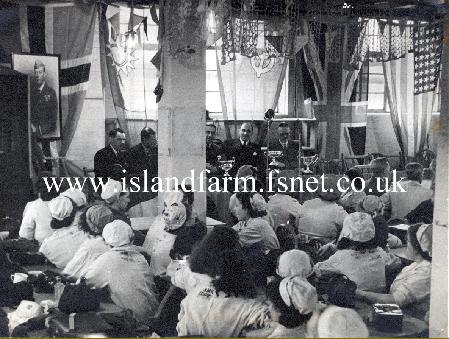
The reason for the photo is unknown, but this is a photo
of what appears to be a meeting in the canteen of The Arsenal
Photo Courtesy of: Ms Connie Thomas Click image to enlarge |

Shunting engine that would have transferred ammunition
between the Admiralty and the Arsenal
Click image to enlarge
|

This sign was placed on the wall in the factory main
building (above)
and informs people of the different air raid siren noises and their meaning Click image to enlarge |

An original fire hydrant
still in place today Click image to enlarge |

The sale of the Admiralty site sold to Abril Corporation
Click image to enlarge
|

Construction of the underground ammunition storage bunkers
Click image to enlarge
|

Emily Gainey (Married name Emily Trahar)
The above photo and the write up were graciously provided by the family Our mother worked on the nightshift in the Arsenal and they would put "Mam" to stand on a table or chair in the corner to sing to the night shift. She travelled by one of the buses from Port Talbot and used to mention seeing the PoWs. Our mother was also in London the night the very first V1 (Doodle Bug) fell on the city. After the war she married James Edward Trahar who was one of the soldiers reescued from Dunkirk. Click image to enlarge |

Eiddwen Rees
The above photo and the hand written account were graciously provided by her granddaughter (Linda Rees Stead) Click this LINK read a truly fascinating hand written account by Eiddwen Rees of her time whilst working in the Bridgend Arsenal. Click image to enlarge |
This Arsenal factory, north east of Bridgend, received the shell cases from "The Admiralty" factory, filled them with ammuntion and stored them in vast underground chambers. The women in this part of the factory had no rubber gloves to protect them from the cordite and over time their hands got stained a yellow colour which gave them the nickname of "Canaries". Incredulously, some of the women would rub the cordite in their hair to blonde it !!

Canaries putting the finishing touches to the shells.
The shell tip colour denoted the firing piece - Artillery, tank, Ship, Plane etc
Click image to enlarge
|
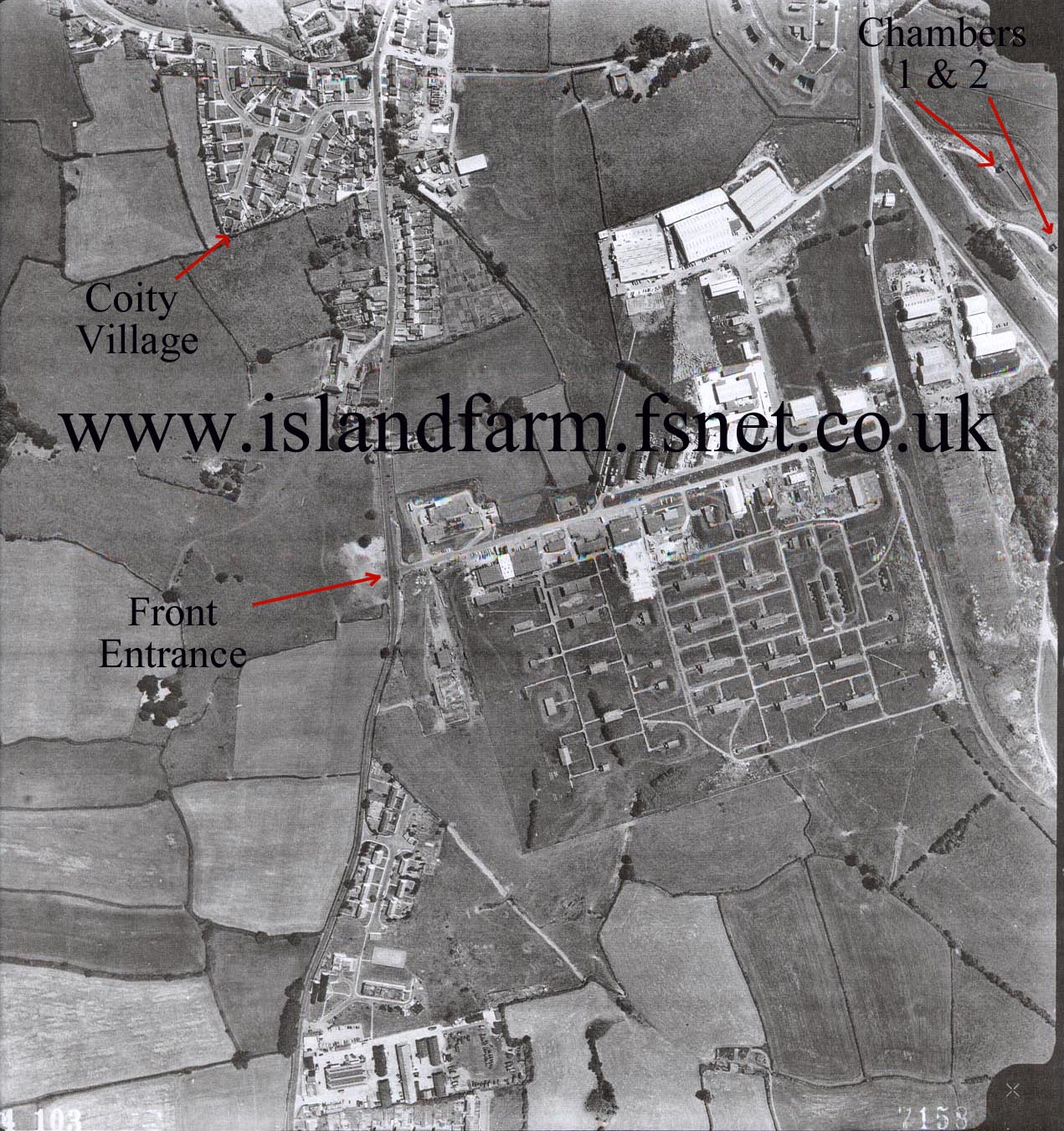
View Of The Arsenal & Coity Village
Click image to enlarge
|
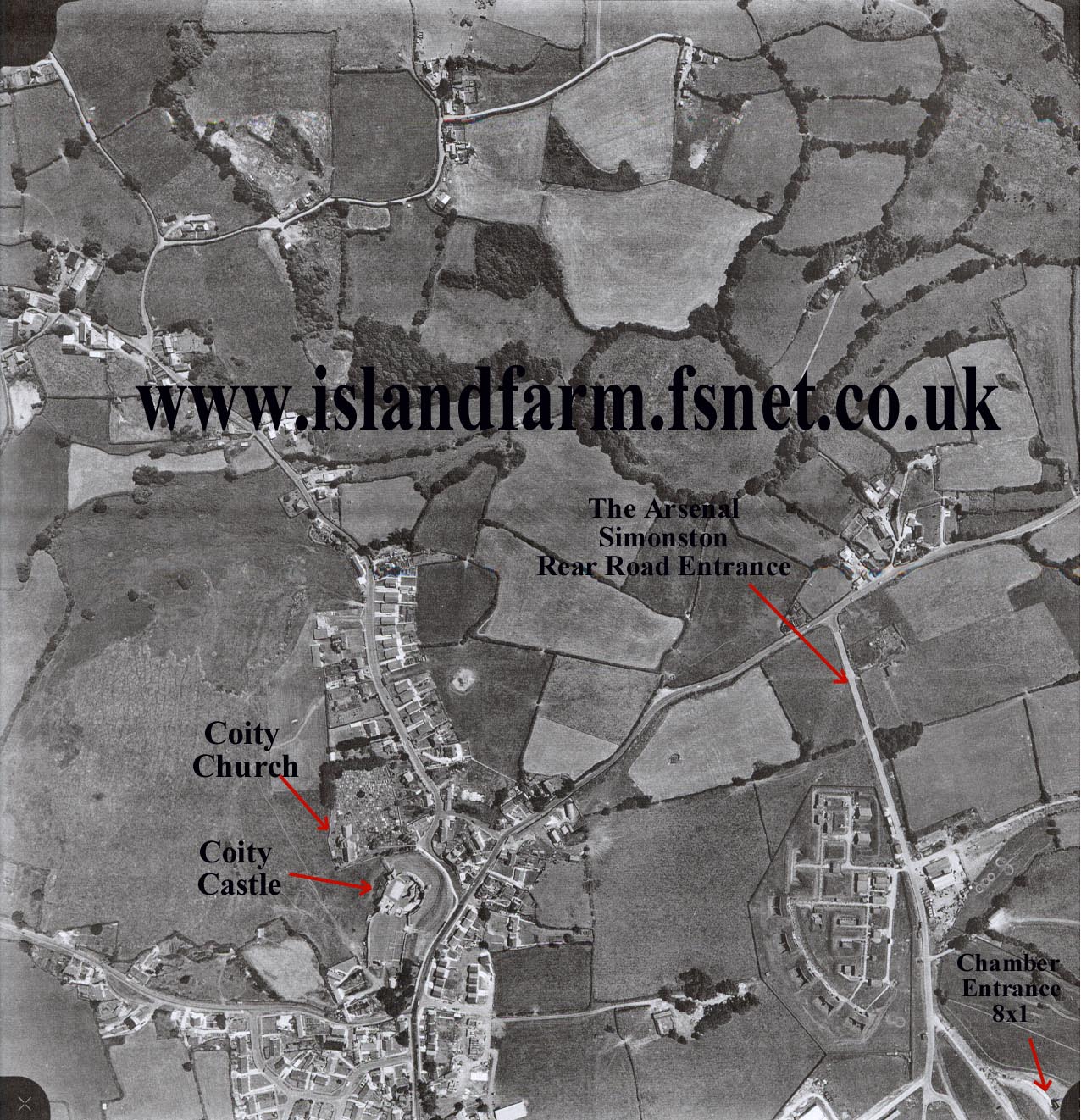
View Of The Arsenal and Simonston Rear Entrance
Click image to enlarge
|

View of The Rear Of the Arsenal Showing Canteen Area
Click image to enlarge
|

The security office for the factory next to the cordite
producing "F" site
Click image to enlarge
|
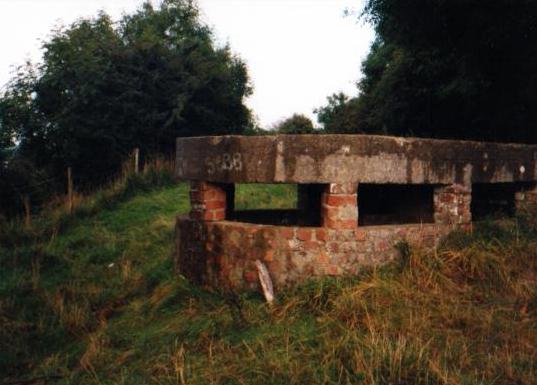
One of many existing pill-boxes along the ridge above the
site
Click image to enlarge
|
.jpg)
The remains of a shop in the "F" site cordite factory
Click image to enlarge
|

Plan, Showing Chamber 5, 6 & 7 in same orientation as
photo to the right
Click image to enlarge
|

The ammunition and filled shells were stored in large
underground heated chambers (my grandfather worked as a boilerman during the nights) and these chambers
were often referred, locally, as the Eight X's. Two of these was maintained up until recently (until the
end of the Cold War) as a nuclear bunker. Each exit entered the hill from the left as you look at the
photo The RGHQ mast can be seen to the left of the picture and the vent for 8x2 can just be made out
slightly below it.
Click image to enlarge
|
8x7 was totally demolished.
8x6 & 8x5 still exist, but the iron rings which were used to support the construction were salvaged for scrap
sometime after its closure, thus making them extremely unstable. The ground is water-logged shale.
8x4 & 8x3 were converted into SRHQ 8.2 in the 1950's. Later becoming RGHQ 8.2. (Nuclear Bunker)
8x1 & 8x2 were of concrete construction and too small for the SRHQ so they have been untouched. The entrances
have been covered, but still exist below ground.

Entrance to Chamber Number 8x1
Click image to enlarge
|

Entrance to Chamber Number 8x1
Click image to enlarge
|
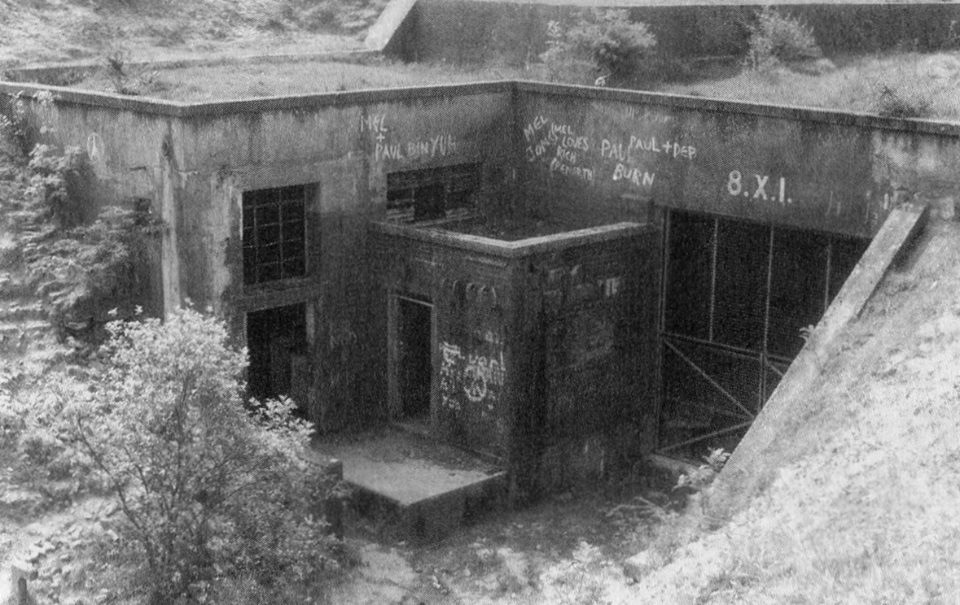
Entrance to Chamber Number 8x1
Click image to enlarge
|

Entrance to Chamber Number 8x2
Click image to enlarge
|

Railway track leading into 8x1 and 8x2
Click image to enlarge
|

8 x 3 Entrance Secured Chamber Used as a Nuclear
Bunker/font>
Click image to enlarge
|

Entrance to Chamber Number 8x7
Click image to enlarge
|

Memorial to the workers killed by accidents within the
factory.
Click this LINK to read the hand written account (Eiddwen Rees above) that details the explosion incident that killed Harry Tantrum honoured on the memorial! Click image to enlarge |