109th INFANTRY HQ REGIMENT
28th Infantry Division
- Division HQ
-
109th
Infantry Regiment
- HQ Regiment - Based at Margam Castle - See report Below
-
1st Battalion:
- 1st Battalion HHC (Headquarters and Headquarters Company)
- A (Able) Rifle Company
- B (Baker) Rifle Company
- C (Charlie) Rifle Company
-
D
(Dog)
Heavy
Weapons Company (armed with machine guns and 81mm mortars to support
the rifle companies)
-
2nd
Battalion
- 2nd Battalion HHC (Headquarters and Headquarters Company) - Based at Island Farm
- E (Easy) Rifle Company
- F (Fox) Rifle Company - Based at Island Farm
- G (George) Rifle Company
-
H
(How) Heavy Weapons Company (armed with machine guns and 81mm mortars
to support the rifle companies)
-
3rd
Battalion
- 3rd Battalion HHC (Headquarters and Headquarters Company)
- I (Item) Rifle Company
- K(King) Rifle Company
- L(Love) Rifle Company
- M(Mike) Heavy Weapons Company (armed with machine guns and 81mm mortars to support the rifle companies)
-
Supported
by:
- 107th Field Artillery Battalion:
- 107th Field Artillery Battalion HHC
- Headquarters Battalion / Battery (Hq)
- Battery A: 4 x 105mm Howitzers.
- Battery B: 4 x 105mm Howitzers.
- Battery C: 4 x 105mm Howitzers.
-
Service
Battery: Managed the lorries, ammunition supply, and vehicle maintenance
- 103rd Medical Battalion ABLE Company
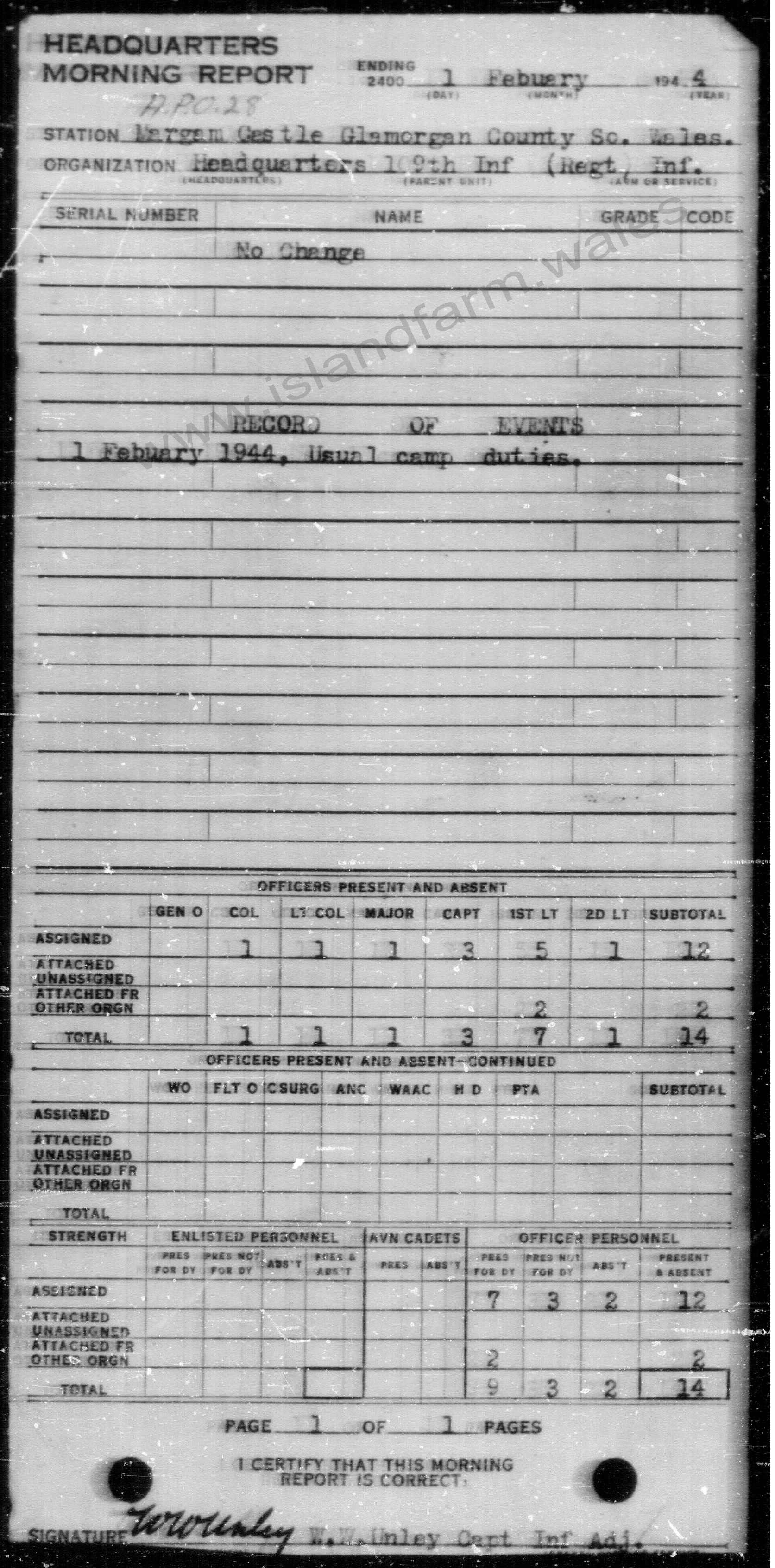
109th Regimental HQ report - 1st February 1944
We can tell it is a Regimental report by:
- The Organisation Line Located at the top of the form under the "Organisation"
heading: It states: "Headquarters 109th Inf (Regt) Inf." Why it matters:
It explicitly includes the abbreviation "(Regt)", which stands for Regiment.
If this were a Battalion report, it would typically say "Hq 1st Bn" or
"HHC 1st Bn". By listing just the "109th Inf," it is identifying the parent
regiment.
- The Rank of Officers Present: The "Officers Present and Absent"
section provides a massive clue through the "Officer Strength" table.
High-Level Ranks: The report shows 1 Colonel and 1 Lieutenant Colonel
assigned. The Logic: In WWII, a Colonel commanded a Regiment. A Battalion
was commanded by a Lieutenant Colonel, meaning you would never see a full
Colonel listed as the "assigned" commander on a Battalion-level report.
Total Staff: There are 14 total officers listed on this page. This reflects
the large staff (Adjutants, Intelligence, Supply) required to run an entire
3,000-man Regiment. A Battalion Headquarters company would have fewer
high-ranking staff officers.
- The Signature and "Adj": At the very bottom, look at the signature of W.W. Unley. The Title: He is listed as "Capt Inf Adj" (Captain, Infantry, Adjutant). The Role: The Regimental Adjutant was the primary administrative officer for the entire Regiment. While battalions had adjutants too, the combination of "Headquarters 109th Inf" and the presence of a Colonel confirms this is the top-tier report for the whole 109th.
NOTE - POSTAL NUMBERS:
At the top of reports you will see numbers e.g. APO28 or APO516-A) etc. These are army post office numbers. Even though both the 372 Engineers and the 109th were both based at Island Farm, they were assigned different APO (Army Post Office) numbers. This is because of how they were organised in the military hierarchy. The difference comes down to whether a unit was "Organic" to a Division or "Independent."
- The 109th Infantry (APO 28)
- The 372nd Engineers (APO
516-A)
The 372nd Engineer General Service Regiment was a non-divisional or "separate" unit.
The System: Because they didn't belong to a specific Infantry Division, they were assigned to the Western Base Section (the regional command for Wales and Northwest England). The Logic:These units were assigned a static APO number based on their physical location or the specific "Base Section" they served. APO 516 was the code for the Bridgend area (specifically associated with the Central Sorting Office or the Base Section handling that region). The "A" Suffix: The "A" in APO 516-A acted like a modern-day postcode extension, specifically identifying the Island Farm Camp site within the Bridgend postal area.
The 109th Infantry Regiment was an organic part of the 28th Infantry Division.
The System:All units belonging to the 28th Division (the 109th, 110th, 112th, artillery, and medics) shared the same base APO number: 28.
The Logic:The Army wanted the mail for the entire Division to go to a single central distribution point. From there, the Division's own postal officers would sort it and send it out to the specific regiments, whether they were at Margam Castle or Island Farm.
Security:Using "APO 28" kept the specific location of the troops a secret from anyone looking at a letter from the outside.